

Yellow-legged Asian hornet (YLAH) action plan
This page explains how Conwy Beekeepers will raise awareness, monitor and respond to the yellow-legged Asian hornet (YLAH) in North Wales.
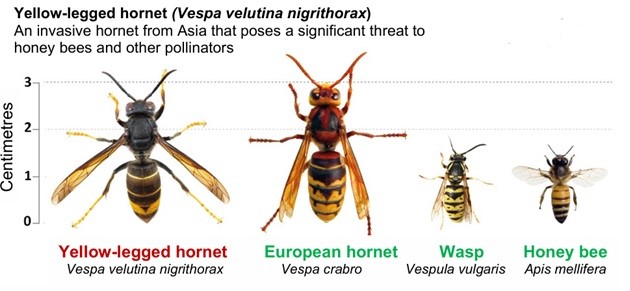
If you think you have seen an Asian hornet
- Take a clear photo if it is safe to do so
- Note the exact location
- Report via the Asian Hornet Watch app or official online form
- Do not approach a nest
Our approach
- Raise awareness
- Monitor for YLAH
- Respond to sightings
- Coordinate AHAT activity
- Support the National Bee Unit (NBU)
The UK response is led by the Animal and Plant Health Agency (APHA) through the National Bee Unit (NBU). Conwy Beekeepers supports this response locally.
1. Raise awareness
CBK maintains an Asian Hornet Action Team (AHAT), led by a coordinator and supported by trained verifiers.
- Promote awareness through social media, talks and workshops
- Encourage reporting via official channels
- Engage local organisations and communities
- Liaise with the NBU on sightings
2. Monitoring
Monitoring focuses on higher-risk areas such as:
- Ports and transport routes
- Lorry parks and warehouses
- Fruit and vegetable wholesalers
- Previous sighting locations
Important: Only use selective traps or open monitoring stations. Non-selective traps harm beneficial insects and should not be used.
All monitoring activity should be recorded with the YLAH Coordinator. Landowner permission and risk assessment are required.
Contact AHAT: asianhornet@conwybeekeepers.org.uk
3. Responding to sightings
- Contact details of the reporter
- A clear photograph
- Accurate location
The NBU will not act without sufficient evidence. Monitoring stations may be used where sightings are suspected.
Dead specimens may be submitted following BeeBase guidance.
4. AHAT activity
- Support Bee Inspectors and the NBU
- Set up and monitor stations
- Assist beekeepers and the public
- Record activity
- Coordinate volunteers
5. Post-response support
After a nest is destroyed, surveillance continues to detect further nests.
- Monitoring near forage areas
- Extended surveillance
- Analysis of specimens
Important: CBK volunteers must never place themselves in danger, particularly if a nest is found. When assessing a sighting, consider PPE, especially if there are reports of multiple hornets.