Compiled by Peter McFadden, Conwy.
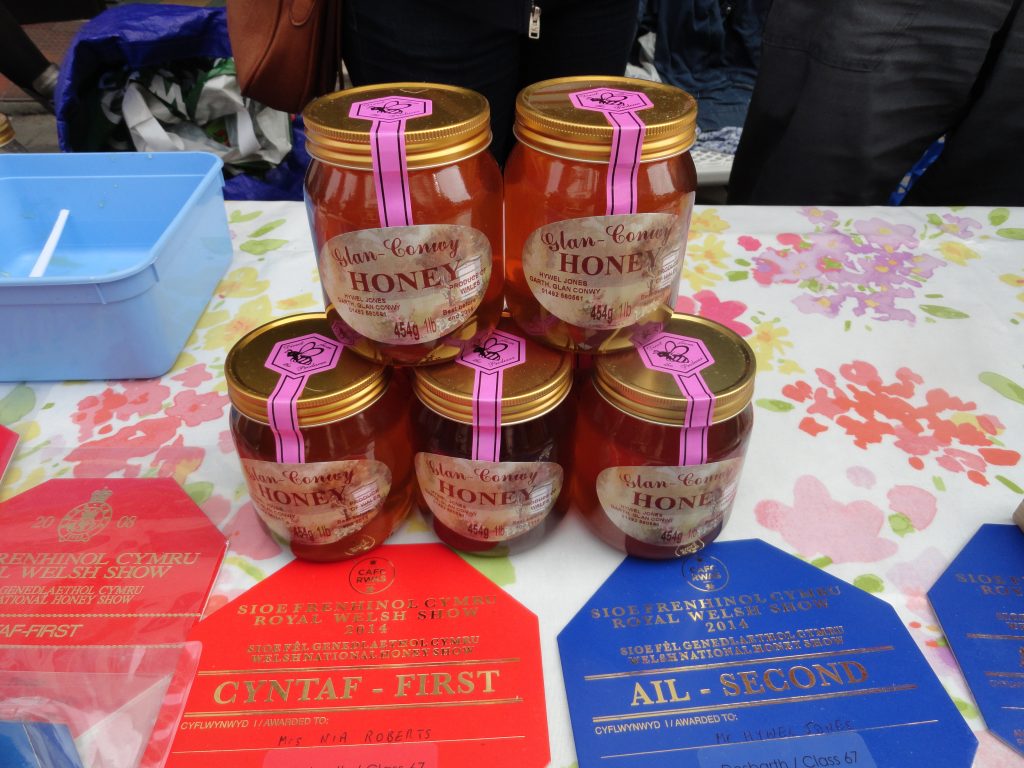
The Conwy Honey Fair in North Wales dates back more than 700 years to the reign of King Edward I, when local beekeepers were first given the right to sell honey within the town walls every 13 September, from midnight to midnight, without charge. The right to hold the Fair is set out in the town’s Royal Charter.
Honey was already an important commodity. Records from 1281–1282 at Rhuddlan Castle include an entry for repairing a cart used to transport a pipe of honey from Aberconwy, before Conwy Castle was built.
By 1835, records note that “large quantities of very excellent honey are sold annually in Conwy”, attributed to heather and wildflowers from surrounding hills (Rev. Robert Williams, History of the Town of Aberconwy, 1835). Honey sold at around two shillings per quart.
Historically, Conwy hosted multiple fairs each year. By the early 20th century, this had grown to ten fairs including butter, wool and horse fairs. Today, only two remain: the Seed Fair (26 March) and the Honey Fair (13 September).
20th Century Development
Early 1900s reports describe fluctuating honey yields, prize competitions introduced in 1904, and strong demand despite weather impacts. The Berry family dominated the Honey Fair between approximately 1850 and 1960, with the Hugh Berry Cup still awarded at Llanrwst Show.
The Fair continued through both World Wars, although honey was scarce at times. By 1918, only one hive survived for one local beekeeper due to disease. Prices rose significantly during this period.
Through the mid-20th century, the Fair evolved with changing locations, introduction of stall charges, and varying participation levels. By the 1980s, it had declined significantly, at one point nearly disappearing.
Modern Revival
In 1990, members of Aberconwy & Colwyn Beekeepers’ Association (now Conwy Beekeepers) took over organisation and promotion, aiming to restore the Honey Fair as a major event. This marked a turning point in its revival.
The opening of the Conwy road tunnel in 1991 improved visitor access, contributing to increased attendance. By the mid-1990s, the Fair regularly attracted large crowds and strong media coverage.
Through the 2000s and 2010s, the Fair continued to grow, often selling over a tonne of honey in a single day. Participation expanded to include plant stalls, crafts and local produce, while maintaining its core identity as a honey-focused event.
Fundraising has also become an important part of the Fair, particularly in support of Bees for Development, with annual collections often exceeding £1,000.
Recent Years
The Honey Fair continued successfully until 2020–2021, when events were cancelled due to the COVID-19 pandemic. Activities resumed in 2022, alongside wider community fundraising efforts.
Local beekeepers remain committed to preserving the Fair’s traditional character while working with Conwy Town Council, Conwy County Borough Council, residents and traders to ensure the event benefits the whole community.
The Conwy Fairs are organised by Conwy Beekeepers on behalf of Conwy Town Council.