Beekeeping exams
Are you serious about beekeeping?
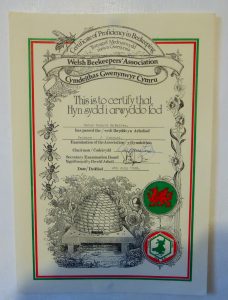
If you have completed an introductory course, kept bees for a couple of years, and attended talks or apiary sessions, you should consider taking the Welsh Beekeepers’ Association (WBKA) Basic Assessment.
View WBKA Basic Assessment details and application
Local support
We can arrange informal pre-assessment apiary sessions at the BeesWales apiary near Tal y Cafn. These allow candidates to compare methods and build confidence.
Assessments usually take place in June or July. Conwy candidates are assessed by an external assessor at BeesWales or Anglesey apiaries.
What the Basic Assessment involves
- Making up a British Standard deep frame of foundation (tools required)
- Opening a hive, handling frames confidently, examining a colony and answering questions
- A question and answer session covering the syllabus (pests and diseases require strong knowledge)
What to bring
- Clean protective clothing
- Smoker, hive tool, uncapping fork and basic equipment
- A jar of honey with lid
- Containers for wax and smoker fuel
- A proper toolbox (not a carrier bag)
Study resources
Mid Bucks BKA Basic Assessment Study Notes (password: mbbka)
Conwy Beekeepers members can contact us for support: secretary@conwybeekeepers.org.uk
The next step
After passing the Basic Assessment and gaining further experience, you may wish to progress to BBKA Modules.
Modules
- 1 – Honey bee management
- 2 – Honey bee products and forage
- 3 – Pests, diseases and poisoning
- 5 – Honey bee biology
- 6 – Honey bee behaviour
- 7 – Selection and breeding
- 8 – Health, management and history
Module 4 has been discontinued.
Preparing for modules
The modules are a significant step up and require structured study over time. Working to a deadline helps build knowledge quickly.
We encourage candidates to form local study groups, attend courses and conventions, and take part in practical sessions.
Peter McFadden, Secretary, Conwy Beekeepers
Updated June 2025