
Measuring winter food stores
All beekeepers know the importance of ensuring that a colony has sufficient food for winter. If necessary, stores can be topped up in mid-winter using fondant or candy.
Many beekeeping books suggest estimating remaining stores by “hefting” the hive — lifting one side to judge the weight. In practice, this can be difficult to assess accurately.
An alternative is to weigh the hive using a portable digital luggage scale. A simple modification allows the scale to hook under one side of the hive. The maximum load is recorded, then the process is repeated on the opposite side. The total hive weight is the sum of the two readings.
This method allows changes in hive weight to be tracked over the winter. The initial level of stores can be estimated either by visual inspection or by weighing the empty hive components and subtracting this from the measured total.
Typical weights for an empty wooden National hive are approximately:
- Single brood box: ~17 kg
- Brood and a half: ~22 kg
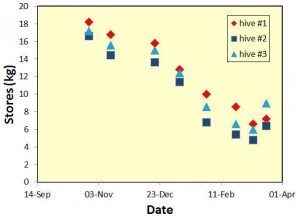
The graph below shows the variation in estimated stores for three colonies over a winter. It also gives an indication of colony activity:
- Steady consumption from October to December
- Faster consumption in January and February as brood rearing begins
- Weight increase in March and April as foraging starts
The average rate of consumption is typically around 0.5–0.7 kg per week.
John Humphreys, Conwy Beekeepers, January 2014