Yellow-legged Asian hornet questions and answers
If you think you have seen a yellow-legged Asian hornet, take a clear photo if it is safe to do so, note the location, and report it using the official reporting routes below. Do not approach a nest.
What is this insect and where does it come from?
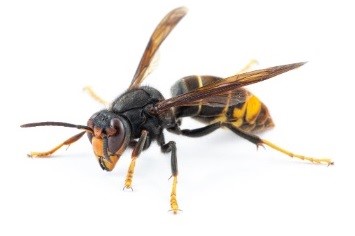
This is the yellow-legged Asian hornet (Vespa velutina), a hornet species originating in South East Asia.
It is now commonly called the yellow-legged Asian hornet to distinguish it from other Asian hornet species. It is an invasive species of concern outside its native range.
What does it look like?
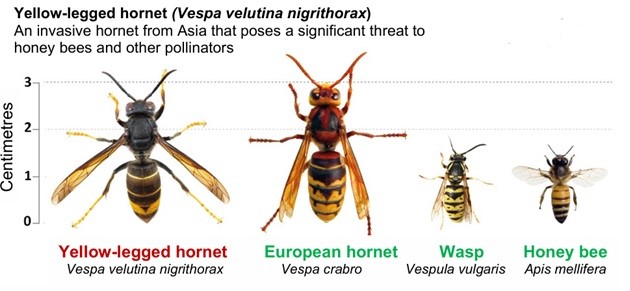
It is slightly smaller than the native European hornet. It has a very dark body, yellow lower legs, and a distinctive orange band on the abdomen.
Is it in the UK?
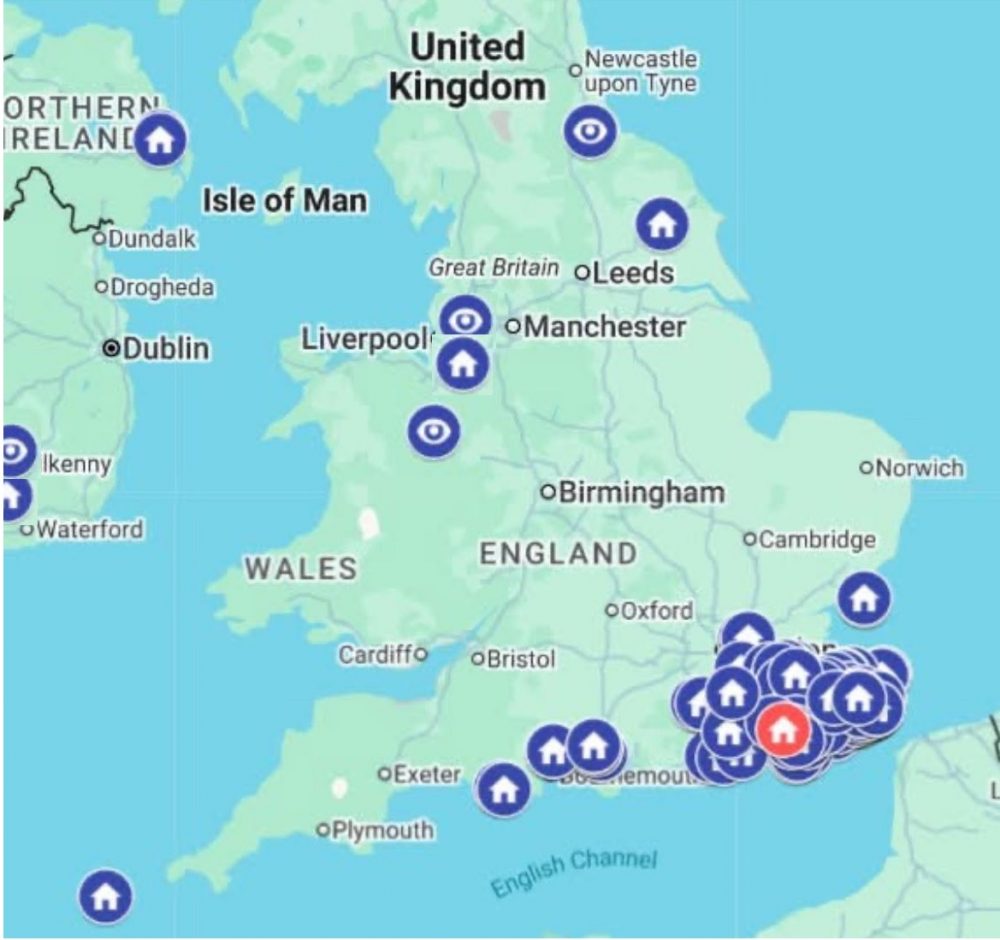
Yes. The first reported UK sighting was in Tetbury, Gloucestershire, in 2016. Since then, there have been reports and nest finds mainly in southern England.
See the BeeBase historic incursion information for official records.
The map gives a snapshot of recent UK sightings and nests, showing the highest concentration in south-east England and illustrating how the species can also spread by hitching rides in vehicles or freight.
Has it been found in Wales?
Update 21 January 2026
See: First finding of yellow-legged hornet in Wales
This confirms that the threat to North Wales is real and that continued awareness and prompt reporting are important.
Is it spreading?
Yes. The yellow-legged Asian hornet has spread widely in parts of Europe. In the UK, the authorities respond quickly to reports in an effort to locate and destroy nests before they become established.
The species can spread naturally, but it can also be moved accidentally in vehicles, freight or produce. Public awareness and rapid reporting are therefore important.
What is the annual life cycle?
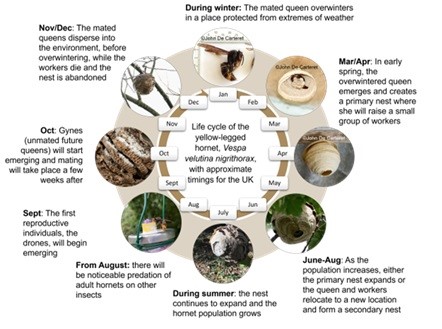
Spring: mated queens emerge from hibernation and begin nest building. They feed mainly on sugary foods such as nectar and tree sap.
Summer: colony size increases and predation on other insects becomes more noticeable.
Autumn: adults continue to seek sugary foods such as ripe or decaying fruit.
Why is it a problem?
The yellow-legged Asian hornet is a significant predator of insects. Over a season, a colony may consume a large quantity of invertebrate prey to feed developing larvae.
This makes it a threat to biodiversity, including honeybees, bumblebees and many other pollinating or beneficial insects.
Will it attack honeybees?
Yes. It may hawk in front of hive entrances and catch bees as they leave or return. This can cause significant stress to a colony.
In serious cases, bees may reduce flying activity, consume stores, and weaken significantly.
Can I just fit an entrance reducer or mouse guard?
No. This is not enough on its own.
What are our hive defence options?
French beekeepers have developed various ways of defending hives. One practical option is a muzzle or wire mesh housing fitted to the hive entrance. This does not stop hawking, but it can reduce direct interception at the entrance and give bees a more protected exit area.
Another method is the electric harp. Further information can be added here when available.
Can I trap yellow-legged Asian hornets?
Yes, but only selectively. Use traps designed to reduce harm to non-target insects. Openings should be sized so larger native species are excluded and smaller insects can escape.
Always use a bait arrangement that avoids drowning insects wherever possible.
Correct identification is important. Native species such as the European hornet, wood wasp and hornet mimic hoverfly are often confused with yellow-legged Asian hornet.
What does a nest look like?
In the early stages, the nest can resemble a wasp nest. It is made from wood pulp but can become much larger and is often a creamy beige colour. Nests are often pear-shaped.
Nests are not always high in trees. They may also be found in hedges, bushes or lower vegetation.
If you find a suspected nest, do not approach it. Report it immediately using the official routes.
What should I do if I think I have seen one?
Take a clear photograph if it is safe to do so.
Download the Asian Hornet Watch app onto your smartphone, or report online using the official alert form.
Please note: reports are much more likely to be actioned when a photograph is included.
You can also report online here: Non-native Alert – Asian Hornet
Safety
The sting is not necessarily worse than that of native wasps or hornets, but reactions vary and multiple stings are especially dangerous.
If hornets are disturbed near a nest, alarm pheromone may attract others quickly. If you see more than one hornet, keep your distance and seek help.
What are verifiers and monitors?
Verifiers respond to reported sightings where a photograph is available. They may also help set and monitor traps as part of a wider team led by a coordinator.
Monitors help by setting traps and observing activity. The coordinator should be informed of all monitoring activity. See our monitoring guide for more detail.
If you would like to help, please contact the association.
How is Conwy Beekeepers preparing?
- Presentations and awareness activity
- Working group looking at traps and defence methods
- Recruiting verifiers to respond to reports
- Regular updates to members
- Website and social media awareness campaign
- Visiting higher-risk locations where appropriate
- Providing talks to local groups
Where can I find more information?
We recommend Andrew Durham’s 2025 book Asian Hornet: the Beekeeper’s Guide.
Online guidance is also available from the National Bee Unit and the British Beekeepers Association.
Conwy Beekeepers Association – updated 21 January 2026
For enquiries, please email asianhornet@conwybeekeepers.org.uk