Quick guide
- Spring (March–May): Use selective traps to detect queens
- Summer–Autumn: Use monitoring stations or traps
- If hornets are reported nearby: Use monitoring stations and observe flight direction
- Always: Avoid non-selective traps and check regularly
Methods of monitoring
Hornet foraging activity can be monitored using traps or monitoring stations.
Traps use bait to attract yellow-legged hornets. Because bait also attracts other invertebrates, only traps that allow non-target insects to escape should be used. Traps should also prevent entry of the larger native European hornet (Vespa crabro).
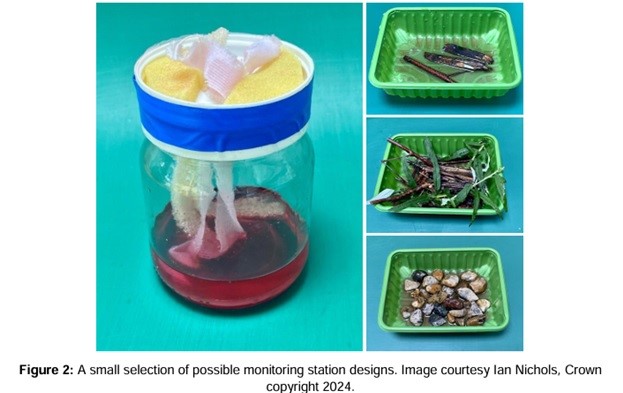
Monitoring stations use an open tray or container with bait, or a closed jar with bait and a wick. These allow insects to feed and fly away. Their main advantage is that non-target insects are not harmed, and the direction of returning hornets can be observed. Their disadvantage is that they require active observation.
Monitoring traps
Traps may be home-made or bought from retailers. They should have different-sized openings so that:
- yellow-legged hornets can enter
- the larger native European hornet is excluded
- smaller non-target insects can escape
Commercial traps vary in how selective they are. It is also important to remember that queens are larger than workers: queens can reach about 30 mm, while workers are up to about 25 mm.
The National Bee Unit has used several selective, non-lethal traps in the field:
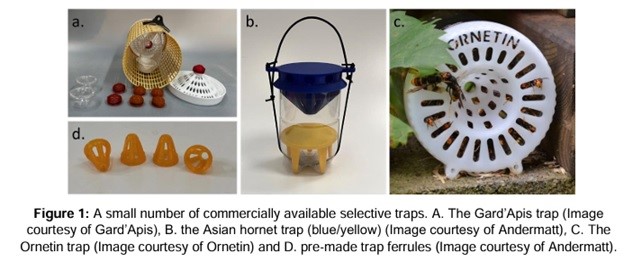
- Gard’Apis trap – supplied with two nozzles: one for queens in spring and a narrower one for workers from May onwards. Side mesh allows smaller insects to escape.
- Andermatt Asian hornet trap – has 8 mm entrance holes and a 5 mm groove to allow smaller insects to escape. A platform above the bait prevents drowning.
- Ornetin trap – fits onto a jar placed on its side, using straw or cotton soaked with bait. Escape holes allow smaller insects to leave while retaining hornets.
Please avoid lethal traps unless they have been modified to reduce harm to native insects. Avoid sticky or glue traps, which may also harm birds.
Check traps regularly, especially when testing a new design, to ensure non-target insects can escape. Also check that traps have not filled with rainwater.
If making your own trap, you can use pre-made ferrules or 3D-printed openings designed to reduce bycatch. Home-made traps should also include a platform or wick to prevent insects from drowning.
Monitoring stations
To set up a monitoring station, place a small amount of bait in a sunny, visible location. If necessary, use a wick or straw so insects do not drown. Check the station regularly through the day.
Please note that although members of the public may not capture and release yellow-legged hornets, monitoring their foraging activity is permitted.
Monitoring stations are unlikely to be useful in spring, when only queens are foraging and chances of detection are low. Spring monitoring is therefore better done using traps. Monitoring stations are more useful later in the season, especially in August, when foraging activity is at its peak.
NBU Inspectors use monitoring stations when hornets are known to be in the area. By watching feeding hornets leave, they can sometimes determine the direction of the nest.
We recommend using monitoring stations when hornets have been reported nearby. Keep a camera ready in case you need to photograph a suspect hornet.
Where should I monitor?
The yellow-legged hornet could arrive anywhere in the UK, but monitoring is especially important near higher-risk locations such as:
- ferry terminals and ports
- distribution routes from Europe
- lorry parks and warehouses
- fruit and vegetable wholesalers
- areas where hornets have previously been found
Monitoring stations and traps work best in sunny places, at head height, and near apiaries or other likely forage areas. Avoid shaded locations.
When should I monitor?
Yellow-legged hornet queens emerge in early spring, so traps for queen monitoring can be placed from March to May. Workers forage throughout the beekeeping season, so monitoring can continue from spring until autumn.
In spring, traps are usually more effective than monitoring stations. Later in the season, either method may be used.
Which bait should I use?
Sweet baits are most attractive to queens in early spring, when they need energy-rich food. Common homemade baits include sugar mixed with dark beer, fruit juice, or alcohol.
In summer, workers also seek protein to feed larvae. Protein baits can include raw fish or meat diluted with water. The NBU has used mashed fish or prawns diluted to about 25% in water. Protein bait should be replaced after three days because it decays quickly and smells strongly.
Later in the season, windfall and ripe fruit may also be attractive. NBU Inspectors use a commercial wasp bait called Trappit, which contains a bee deterrent and can be used throughout the year.
How do I empty monitoring traps?
Release all live native insects wherever possible. Traps should ideally be checked daily.
Take care when releasing stinging insects. If necessary, traps can be chilled in a fridge for about 30 minutes until the insects slow down, then emptied outdoors somewhere warm and dry so they can recover and fly away.
If you think you have caught a yellow-legged hornet, place the whole unopened trap in a sealed freezer bag and freeze it for 12 hours before opening. Alternatively, the trap can be placed in a bucket of soapy water for an hour so the hornet can be removed safely.
How do I know if I have caught a yellow-legged Asian hornet?
There are many misidentifications every year, so it is important to learn the key features before submitting a report. Please familiarise yourself with the identification guidance before reporting a suspected sighting.
See: National Bee Unit – Asian hornet guidance
Conwy Beekeepers acknowledges and thanks the National Bee Unit for the information summarised above.
December 2025