Preparing the bees for winter
The main causes of winter losses are queenless colonies, starvation, varroa and damp in the hives. All of these are within your control. Your bees are a valuable asset and deserve your best attention. You should aim for zero winter losses.
Aim to complete your winter preparation by late September. Use our Winter Prep record card to keep track of your preparation rather than relying on memory. These notes apply to hives that are not moved to the heather in August.
Step 1
In mid August, check that the colony has a laying queen. Look for eggs, larvae and sealed brood, and record the results. If there is no queen, unite the colony with a queenright colony or call for help.
Your colony should have at least five deep frames of bees. I winter my hives on a brood and a half, or more often now a double brood, plus one part-filled super of honey, with no queen excluder. Check that the hive parts are sound.
Step 2
At the end of August, remove any part-filled supers for refitting later. Check the weight of the hive by hefting one side from the stand. The hive should feel very heavy. I leave all the honey in the brood box and half brood box for the bees.
If your hives feel heavy enough without feeding, go straight to Step 3. A colony will need the equivalent of about 18kg of honey or sugar syrup to survive the winter. Any ivy honey stored in September is a bonus.
Feed any light hives with a rapid feeder, preferably a Miller or Ashforth tray feeder. These allow you to feed up to 10 litres of syrup at a time. Winter feeding should take only a few days.
Your hive stands must be level if using a tray feeder, otherwise bees may drown in pools of syrup. Make the syrup with one electric kettle full of hot water to 3 × 1kg bags of sugar. Reduce the hive entrance when feeding, and feed in the evening to prevent robbing.
Aim to finish winter feeding by early September. Feeding while the weather is still warm will stimulate the queen to continue laying for a while. If you delay until October, the feed may go mouldy because the bees will not take it down properly.
Step 3
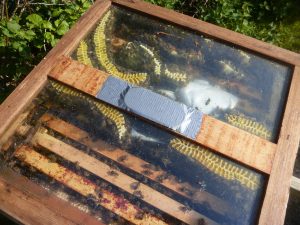
Remove the empty feeder when the hive weight is satisfactory. Place an eke, a 25mm high square wooden frame, on the top brood box. Place a tray of Apiguard on the top brood frames, open side up, and refit the crown board on the eke with the feed holes sealed.
If using an open mesh floor, fit the mite catch tray and put a square of carpet or a slab of 25mm Kingspan insulation on the crown board. This stays on all winter. I leave top insulation on my hives all year round, though that is a matter of choice.
Aim to fit your first tray of Apiguard by early September. You want a hive full of healthy bees going into winter. If you wait until October, it is too late.
Step 4
After 10 days, remove the mite catch tray and check whether the mite drop is low, medium or high compared with your other hives. Record the results, scrape the tray clean and refit it.
Check whether the Apiguard tray has been emptied. If yes, fit the second tray and leave the first tray in place as a reminder. If not, wait a further four days and then fit the second tray.
Step 5
After two more weeks, remove both aluminium Apiguard trays for recycling. Scrape any remaining Apiguard onto the top frames. Remove the eke and the mite catch tray. Clean and store them for winter.
Scrub the catch tray with washing soda solution. See our notes on cleaning beekeeping equipment.
Note: If there is a late honey flow, you may find that the eke has been filled with wild comb and honey. Remove this.
Step 6
Optional, on the same day as Step 5: fit a super of drawn combs, including any part-filled combs or combs wet from extracting, to store late season honey from Himalayan balsam or ivy. A queen excluder is not needed in winter.
I always store drawn combs dry, but that is your choice.
Step 7
In early October, remove the entrance block and fit a mouse guard.
Now you can relax and go on a short holiday.
Note 1: Changing varroa treatment
Our Seasonal Bee Inspector recommends changing the varroa treatment every two years. Apivar and Apistan strips are easy to use. They are hung between the brood combs and do not require an eke. Remember to remove the strips at the end of the treatment.
We welcome your comments. Please email the Secretary at secretary@conwybeekeepers.org.uk.
Updated August 2025